←
Back to Blog
AI
•
•
Team PixelPilot
•
5 min read
ML Ops: Training, Serving, Monitoring
Define the training, serving, and monitoring pipelines that keep ai models dependable — from early experiments to produc
Introduction
Machine Learning (ML) has transformed how organizations make predictions, automate processes, and deliver personalized experiences. However, building ML models is only part of the journey. To deploy ML successfully at scale, organizations need ML Operations, or ML Ops, which focuses on the lifecycle of ML models—including training, serving, and monitoring.
ML Ops bridges the gap between data science and software engineering, ensuring that models are reproducible, reliable, and continuously improving. By adopting ML Ops practices, organizations can reduce downtime, prevent model drift, and ensure that AI-driven systems remain accurate and effective in production environments.
Model Training
The Purpose of Training
Training is the process of teaching a model to recognize patterns in data. The model learns from labeled datasets or historical examples to make predictions or classifications on new data. Proper training ensures that the model generalizes well and avoids overfitting or underfitting.
Key Steps in Training
Data Collection: Gathering relevant, high-quality data that represents the problem domain
Data Preprocessing: Cleaning, normalizing, and transforming data to ensure consistency and reduce noise
Feature Engineering: Selecting, creating, or transforming variables to improve model accuracy
Model Selection: Choosing algorithms suitable for the task, such as regression, classification, or deep learning
Hyperparameter Tuning: Adjusting model parameters to optimize performance
Validation: Testing the model on unseen data to ensure it generalizes well
Best Practices
Maintain version control for datasets and model configurations
Use reproducible pipelines to ensure experiments can be replicated
Automate training using pipelines or frameworks such as Kubeflow, MLflow, or Airflow
Document assumptions, parameters, and performance metrics
Business Impact
Efficient training processes ensure faster experimentation, more accurate models, and reliable deployment. This reduces the time to market for AI-driven features and improves decision-making quality.
Model Serving
The Purpose of Serving
Serving refers to deploying a trained model so it can make predictions on new, real-world data. This stage ensures that the model is accessible to applications, APIs, or end-users in a reliable and scalable way.
Key Approaches
Batch Serving: Models process large datasets at scheduled intervals, ideal for reporting, analytics, or recommendations
Online Serving: Real-time predictions are provided for individual requests, crucial for personalized experiences, fraud detection, or dynamic pricing
Microservices Deployment: Models are deployed as independent services, allowing easy scaling, versioning, and maintenance
Best Practices
Containerize models using Docker or Kubernetes for portability and scalability
Implement versioning to manage multiple models in production
Use caching and load balancing to handle high traffic efficiently
Secure endpoints to prevent unauthorized access or data leaks
Business Impact
Proper serving ensures reliable and fast predictions, improving user experience and operational efficiency. It also allows teams to deploy multiple models safely and update them without downtime.
Model Monitoring
The Purpose of Monitoring
Monitoring ensures that ML models continue to perform well after deployment. Models can degrade over time due to changes in data, user behavior, or external factors—a phenomenon known as model drift. Monitoring identifies performance issues and ensures models remain accurate and reliable.
Key Monitoring Metrics
Accuracy and Error Rates: Track prediction correctness over time
Data Drift: Detect changes in input data distribution that could affect model performance
Prediction Drift: Monitor shifts in the output predictions
Latency and Throughput: Ensure predictions meet performance requirements
Resource Utilization: Monitor memory, CPU, and GPU usage for efficiency
Best Practices
Set up automated alerts for anomalies or significant drops in performance
Retrain models when drift is detected or periodically to maintain accuracy
Log predictions, input data, and outcomes for auditing and debugging
Visualize performance metrics in dashboards for easy monitoring
Business Impact
Monitoring prevents business risks caused by inaccurate predictions, improves compliance, and ensures consistent user experience. It allows teams to respond proactively to changing conditions, avoiding costly mistakes or reputational damage.
Integrating ML Ops
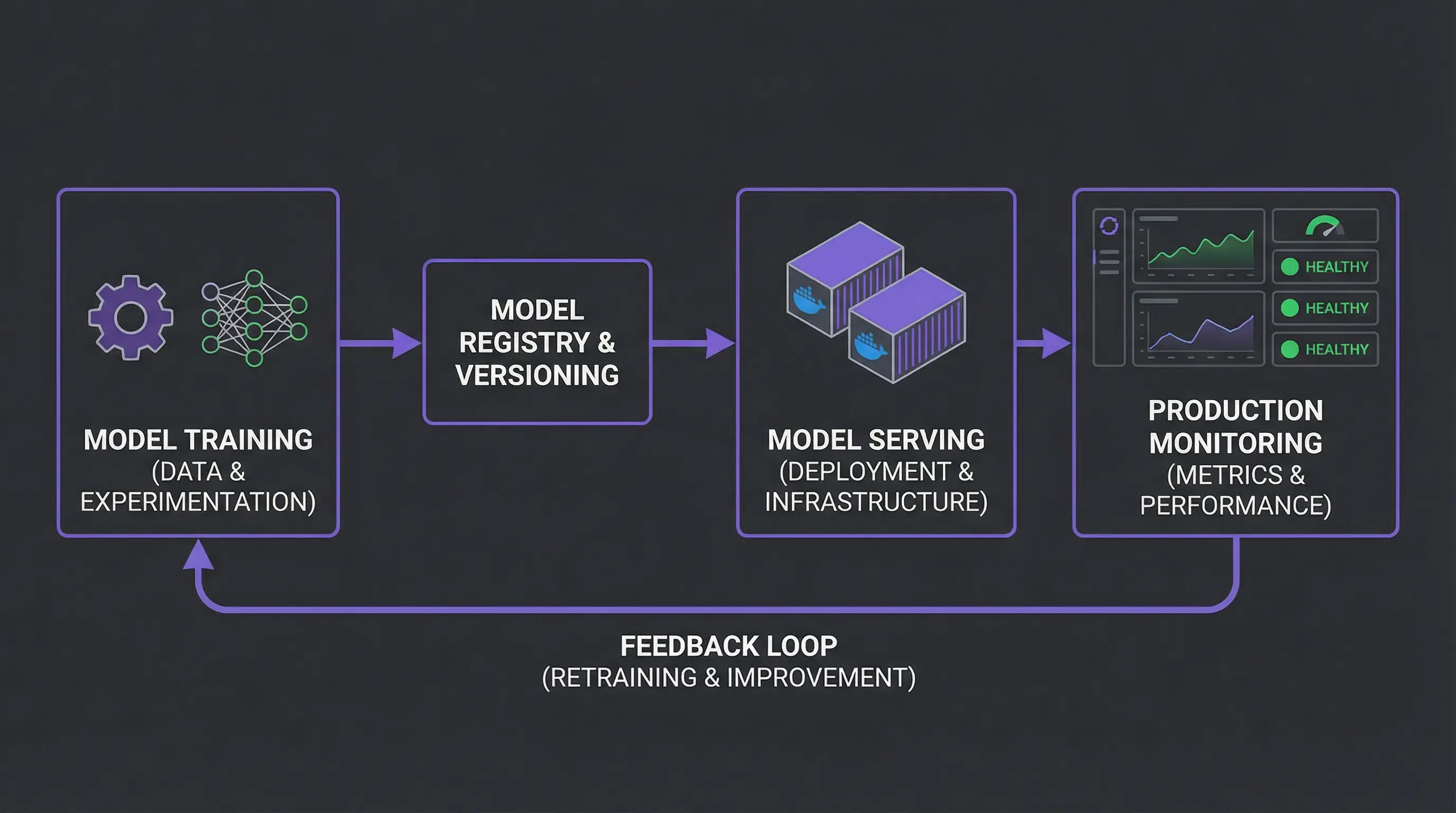
ML Ops is most effective when all stages—training, serving, and monitoring—are integrated into a seamless lifecycle:
Automated Pipelines: Connect data ingestion, model training, deployment, and monitoring into repeatable pipelines
Collaboration Tools: Enable data scientists, engineers, and operations teams to share models, datasets, and metrics
Continuous Feedback Loops: Feed monitored data back into training pipelines to improve model performance over time
Challenges and Considerations
Scalability: Handling large datasets and high-traffic prediction requests
Compliance: Ensuring models meet privacy, security, and regulatory requirements
Reproducibility: Maintaining consistent results across different environments
Cost Management: Balancing compute resources for training and serving without overspending
Addressing these challenges requires careful planning, automation, and cross-functional collaboration.
Conclusion
ML Ops transforms machine learning from a one-off experiment into a reliable, production-ready system. By focusing on training, serving, and monitoring, organizations ensure that ML models remain accurate, scalable, and valuable over time.
Adopting ML Ops practices allows businesses to accelerate AI deployment, reduce operational risks, maintain compliance, and continuously improve model performance. Ultimately, ML Ops bridges the gap between data science innovation and business impact, turning AI into a dependable driver of growth.
Need help with your digital project?
Our team builds websites, mobile apps, e-commerce platforms and runs data-driven marketing campaigns for businesses across the UK.